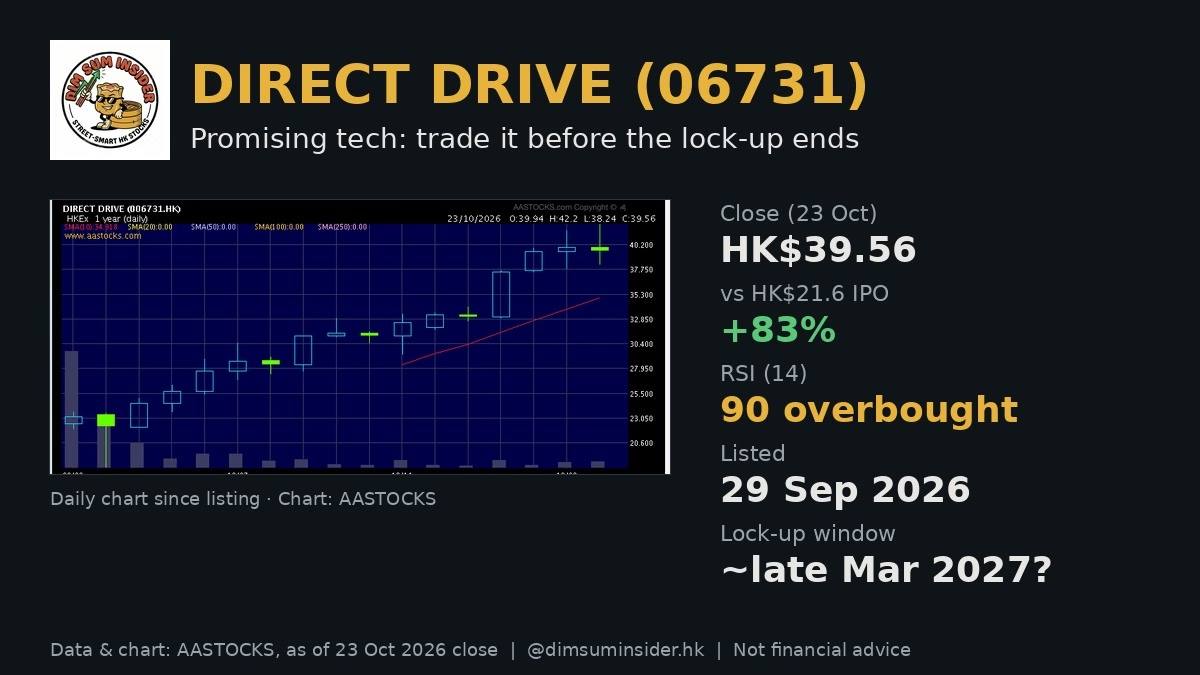
Less than a month after listing, Direct Drive (06731), the Hong Kong robotics start-up known in Chinese as 本末科技, has run from a HK$21.6 IPO price to HK$39.56 at Friday’s close, a gain of about 83%. This Direct Drive 06731 stock analysis asks the alpha question: the technology is promising, but is this a stock to own, or a stock to trade before the lock-up ends?
Market commentary notes take the second view: the company has real potential, the valuation is rich against revenue, and the stock can keep running at least until restricted shares are released, as long as you keep a strict stop-loss.
The news in brief
- Hot IPO, calm debut. Direct Drive listed on 29 Sep 2026 after being more than 200 times oversubscribed. It opened at HK$22.48 (+4.1%) and closed day one at HK$23.20, up 7.4% on the HK$21.6 offer price (AASTOCKS). Market commentary calls that debut “fairly rational”.
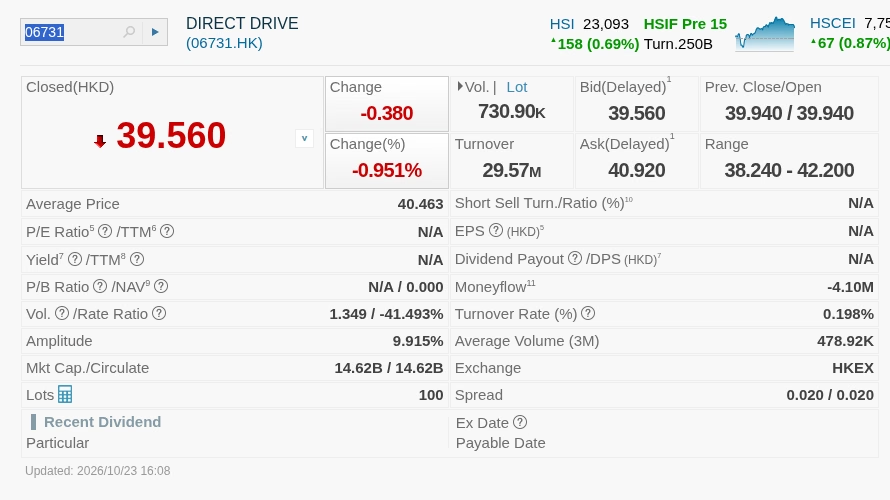
- Steady climb since. On 22 Oct the stock rose 1.1% to HK$39.94 while the broader market fell sharply. On 23 Oct it slipped 0.95% to HK$39.56 after touching an intraday HK$42.20 (AASTOCKS).
- Pedigree. Founded by a team from the Hong Kong University of Science and Technology (HKUST), with deep involvement from Professor Li Zexiang, often called the “godfather of DJI”. Li taught DJI founder Frank Wang at HKUST and backed him early. Li also founded Googol Technology and co-founded the XbotPark robotics base in Dongguan’s Songshan Lake, which has incubated names such as Narwal, EcoFlow, Hai Robotics and CiDi (03881).
- The idea. Founder Zhang Di, an HKUST robotics master’s graduate, removed the gearbox (reducer) from a robot drive system and drove it directly, finding big gains in noise and simplicity. The company was set up in April 2020 and closed a seed round within a month, with follow-on money from Li-controlled investors.
- Fast growth, still loss-making. Revenue was 17.54m (2023), 79.80m (2024) and 282m (2025) yuan, and already 200m in 1H2026. Adjusted net losses were 61.22m, 61.59m, 43.25m and 27.50m over the same periods. Gross margin has held around 20%.
- The call: pricey on sales, but likely to be traded higher before the lock-up expires. Use a strict stop.
What Direct Drive actually does
1. Direct-drive modules for consumer robots. The core business is direct-drive hub motors and drive modules for robot vacuums, robot lawnmowers and vacuum cleaners. With no reduction gears, the modules are quieter, more durable, smaller and use less power. Market commentary notes the company had over 60% share of China’s consumer-robot direct-drive module market in 2025 and is a core supplier to leading robot-vacuum brands Dreame and Roborock.
2. Embodied-intelligence joints and robots. The second line is joint modules and complete machines: the Xingtian (刑天) and Tita wheel-legged robots for university research, security patrol and industrial exploration, plus integrated force-controlled direct-drive and quasi-direct-drive joint modules for humanoid and quadruped robots, including humanoid lower limbs and dexterous actuators.
The catch: embodied-intelligence joints and machines are only about 5–7% of revenue today. More than 90% still comes from parts for consumer cleaning appliances.
Where the growth comes from
- Overseas lawnmowers. Market commentary sees most growth in exports and the overseas robot-lawnmower market, as Western garden mowers shift to lithium battery and smart models. Drive-wheel modules there typically carry higher gross margins than domestic robot-vacuum parts, which could improve the profit mix.
- Quieter, thinner robots. The trend toward low-noise, slimmer vacuums and mowers keeps the “direct drive replaces gearbox” story going, but this is a maturing business.
- Humanoids are the option value. As humanoid and wheel-legged industrial robots move into mass-production validation, high-response, high-power-density direct-drive joints are one of the key technical routes. That is what the market is paying for.
Direct Drive 06731 stock analysis: valuation and key numbers
| Metric | Direct Drive (06731) |
|---|---|
| Last price (23 Oct close) | HK$39.56 |
| Day change | -HK$0.38 (-0.95%) |
| Prev close / open | HK$39.94 / HK$39.94 |
| Day range | HK$38.24 – 42.20 |
| High / low since listing | HK$41.62 / HK$18.20 |
| IPO price / gain since | HK$21.6 / about +83% |
| Debut day (29 Sep) | Open HK$22.48 (+4.1%), close HK$23.20 (+7.4%) |
| Market cap | HK$14.62B |
| P/E / yield / P/B | N/A (loss-making, newly listed) |
| SMA 10 | 34.918 |
| RSI 14 | 90.25 (overbought) |
| Volume / turnover | 730.9K / HK$29.57M |
| Financials (yuan, as cited) | 2023 | 2024 | 2025 | 1H2026 |
|---|---|---|---|---|
| Revenue | 17.54m | 79.80m | 282m | 200m |
| Adjusted net loss | 61.22m | 61.59m | 43.25m | 27.50m |
| Gross margin | ~20% | ~20% | ~20% | ~20% |
What the numbers tell us (our analysis):
- Growth is real. Revenue grew about 4.5x in 2024 and 3.5x in 2025, and 1H2026 is already about 70% of full-year 2025.
- Losses are narrowing, from about 61m a year to 27.5m in the half. But a steady ~20% gross margin is low for a “tech” multiple: this is still a components business today.
- Rich on sales. A HK$14.62B market cap against 2025 revenue of 282m yuan is roughly 50x sales on our rough maths. Market commentary agrees it looks expensive relative to revenue, but says investors are willing to pay a premium for its specific story.
Technical analysis: a straight line up, now overbought
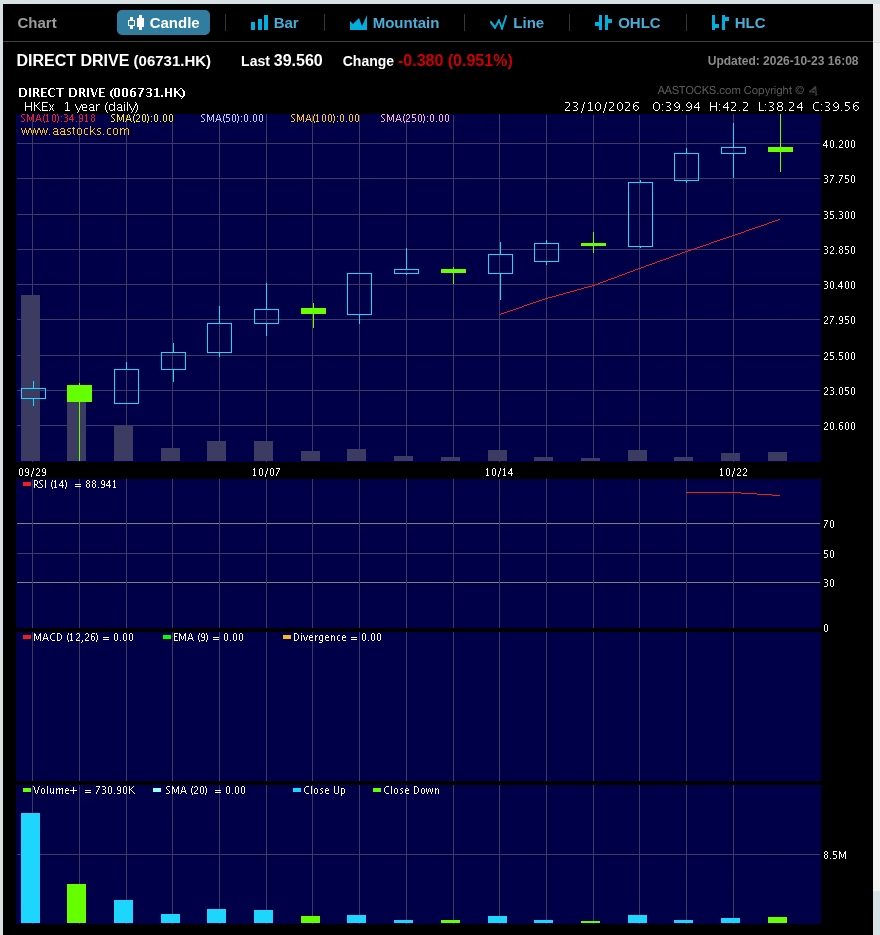
In about 16 trading days the chart has been almost one-way: a near-vertical staircase from the low HK$20s to the low HK$40s. Price sits well above the 10-day SMA at HK$34.92. With so little history, the 20-, 50- and longer averages and MACD are not yet meaningful.
- Very overbought. RSI(14) at 90.25 is extreme. That does not mean it must fall, but it does mean new buyers are paying up for momentum.
- Rejection at the highs. On Friday the stock spiked to HK$42.20 and gave most of it back to close at HK$39.56, a small warning sign.
- Volume has faded. Turnover is far below the debut-week levels. Market commentary suggests waiting for a consolidation or a flag pattern to buy rather than chasing.
Levels: first support is the HK$37–38 area from the 21–22 Oct candles and Friday’s HK$38.24 low, then the 10-day SMA near HK$34.9. Resistance is HK$41.6–42.2, the high since listing and Friday’s intraday spike.
Lock-up timing: when do the restricted shares unlock?
Market commentary’s trade is explicitly time-boxed: ride it before restricted shares are released. In Hong Kong IPOs, cornerstone investors are typically locked up for six months from listing, and controlling shareholders face at least six months under listing rules. Pre-IPO investors’ lock-ups depend on their agreements. Counting six months from the 29 Sep 2026 listing points to around late March 2027 as the first likely window.
We have not verified Direct Drive’s exact lock-up terms, who is locked up or for how long. Check the prospectus for cornerstone, pre-IPO and controlling-shareholder lock-up dates and share counts before you use them to time a trade.
Bull case vs bear case
Bull case
- Strong pedigree: HKUST, Li Zexiang and the XbotPark ecosystem that produced DJI-linked successes.
- Over 60% share of China’s consumer-robot direct-drive module market (2025), supplying Dreame and Roborock.
- Revenue up more than 15x from 2023 to 2025, with losses shrinking.
- Overseas lawnmowers offer higher margins; humanoid joints give the stock a hot theme.
Bear case
- More than 90% of revenue still comes from consumer cleaning-appliance parts; embodied AI is only 5–7%.
- Gross margin stuck around 20% and the company is still loss-making.
- About 50x 2025 sales on our rough maths, and up 83% from the IPO price in under a month.
- RSI above 90, and the lock-up expiry could bring a wave of supply.
Levels to watch
- HK$41.6–42.2. A close above the post-listing high would extend the run.
- HK$38.24. Friday’s low; a break would signal the first real pullback.
- HK$34.9 (10-day SMA). The trend line for momentum traders. A close below it is a natural stop-loss trigger.
- Consolidation or flag. Market commentary’s preferred entry, rather than chasing.
- Lock-up dates. Check the prospectus; late March 2027 is the likely first window if a standard six-month lock-up applies.
The DimSumInsider take
Direct Drive is a genuine tech story with a great family tree, but today it is a components maker trading on a humanoid-robot dream. That is fine for a trade, not for a buy-and-forget. Our approach: wait for the RSI to cool through a consolidation, size small, keep a hard stop under the 10-day line, and plan to be lighter well ahead of the lock-up expiry. The alpha is riding the theme, not marrying it.
FAQ
What does Direct Drive (06731) do?
It makes direct-drive motors and drive modules for robot vacuums, robot lawnmowers and vacuum cleaners, plus joint modules and wheel-legged robots (Xingtian, Tita) for embodied-intelligence and humanoid robotics.
How has 06731 done since its IPO?
It was priced at HK$21.6, listed on 29 Sep 2026, closed day one at HK$23.20 (+7.4%) and closed at HK$39.56 on 23 Oct 2026, up about 83% (AASTOCKS).
Is Direct Drive profitable?
No. Adjusted net losses were 61.22m, 61.59m and 43.25m yuan in 2023–2025 and 27.50m in 1H2026, while revenue grew to 282m in 2025 and 200m in 1H2026.
When does the Direct Drive lock-up expire?
A standard six-month lock-up from the 29 Sep 2026 listing would end around late March 2027. Check the prospectus for the exact dates and which shareholders are covered.
What are the key technical levels?
Support at HK$38.24 and the 10-day SMA near HK$34.9; resistance at HK$41.6–42.2. RSI(14) is about 90, deeply overbought.
Disclaimer: For information only. Based on public market commentary notes and AASTOCKS data as of 23 Oct 2026 close; data may be delayed. DimSumInsider may hold positions not stated here. Consult a licensed financial adviser. This is not financial advice. Do your own research.
Leave a Reply