
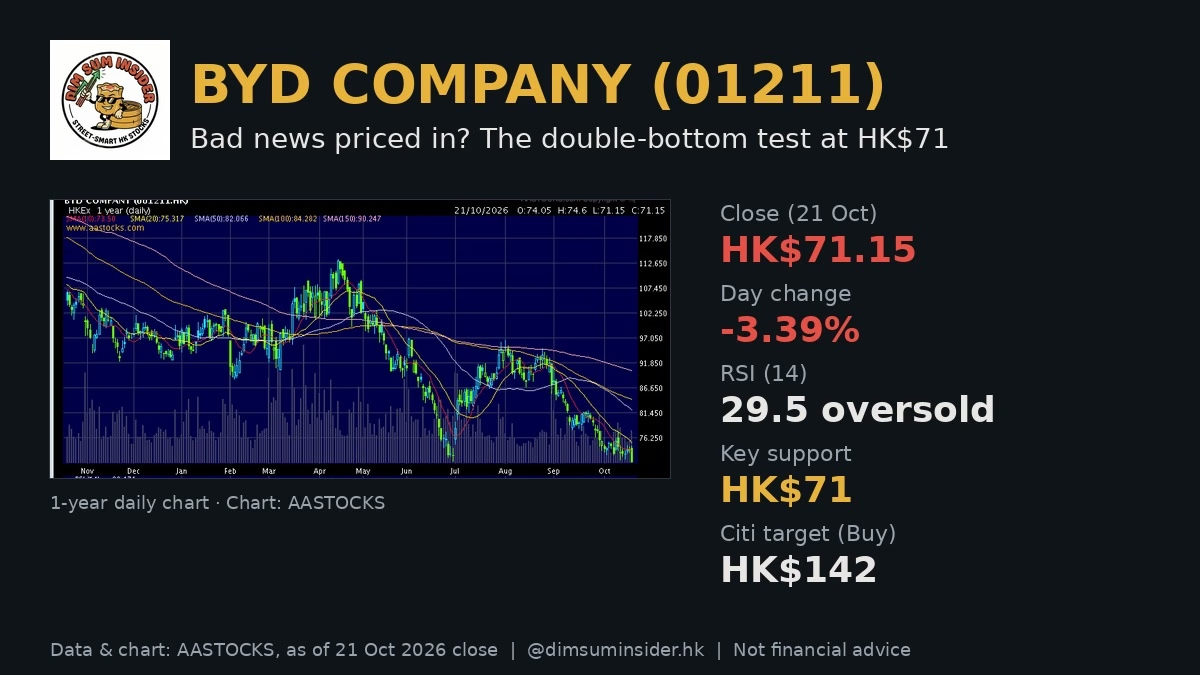
China EV stocks have been the market’s favourite punching bag all autumn, and on Wednesday the selling got loud: CATL dropped more than 11%, the Hang Seng Tech Index hit a two-year-plus low, and BYD (01211) closed down 3.4% at HK$71.15, a fresh 52-week-low zone. This BYD 01211 stock analysis asks the contrarian question: is the bad news finally priced in, and is a double bottom forming at HK$71?
The bear list is well known: a domestic price war, slowing China growth and European restrictions on Chinese EVs. The bull reply from market commentary notes is that all three are now in the price, the European overhang has been settled, and Citi still says Buy with a HK$142 target. Q3 results land at the end of October.
The news in brief
- Sector mood is ugly. On 21 Oct the Hang Seng Index reversed to close down 215 points, HSTECH hit a 2+ year low and CATL plunged over 11%. On 20 Oct four Chinese authorities held a symposium with more than 30 automakers on design and R&D testing management, and on 16 Oct Citi research flagged that China’s battery supply-chain peak season was weaker than expected.
- Why NEV stocks de-rated: fierce domestic competition means investors now value the sector like a mature industry growing at single-digit to low-double-digit rates, and news of European curbs on Chinese EVs kept surfacing.
- Europe overhang cleared: the EU and China agreed a minimum-price arrangement on EV tariffs from 1 Dec 2026. Imports of China-made hybrids (HEV and PHEV) are capped at 350,000 units a year for four years, and Chinese brands assembling locally are exempt.
- Local capacity: BYD’s Szeged, Hungary plant is expected to start production at the end of 2026 with planned capacity of 300,000 units.
- 1H2026 results: revenue about RMB344.8bn (-7.1% YoY), net profit about RMB12.3bn (-20.5%), but gross profit up 2.81% to RMB64.989bn and gross margin up 0.84pp to 18.85%. Operating cash inflow rose 17.3% to RMB37.335bn.
- Overseas engine: 1H overseas car sales of 792,000 units (+67.8%) and overseas revenue of RMB181.3bn.
- Citi: expects Q3 net profit of RMB12.95bn (excluding FX and BYD Electronic (00285) contribution), maintains Buy with an H-share target of HK$142.
Fundamentals: shrinking at home, sprinting abroad
The 1H numbers look bad on the headline and better underneath. Revenue fell 7.1% and net profit 20.5% as the domestic price war ate into per-car profit. Yet gross profit actually rose 2.81% and gross margin improved 0.84pp to 18.85%. The reason is mix: overseas cars earn clearly higher net margin per vehicle than domestic ones, and the overseas share of both volume and revenue keeps climbing.
The overseas numbers are now the core of the story. 792,000 cars sold abroad in the half (+67.8%) and RMB181.3bn of overseas revenue, which is more than half of the RMB344.8bn group total on our maths. Plants in Thailand and Brazil are ramping and Hungary is next.
At home, the RMB100k-200k mainstream band is a knife fight with Geely (00175), Changan and the new EV makers. BYD’s battery vertical integration and technology upgrades mean its margin decline is still milder than most rivals’. Volume support comes from the 5th-generation DM hybrid technology and trade-in subsidies; domestically the goal is to defend share, while growth comes from Europe, Southeast Asia and Latin America.
Two quality flags worth noting:
- Cash is better than profit. Operating cash inflow up 17.3% while net profit fell 20.5% suggests earnings quality is holding up.
- Inventory discipline. After earlier pushes of stock into dealers, the factory has adjusted production to avoid squeezing dealer cash flow. Good for the channel, but it caps near-term volume.
Europe: the overhang that just got a ceiling
Markets hate open-ended risk. The EU-China deal turns an unknown into a number: a 350,000-unit annual quota for China-made hybrids for four years, effective 1 Dec 2026, with local assembly exempt. That is exactly why Szeged matters: 300,000 units of EU-made capacity from the end of 2026 sits outside the quota.
Citi’s view is that FY2027 exports to Western Europe have limited downside: even with a hybrid cap, China’s EV exports to Western Europe should stay roughly flat, helped by local capacity rising to 400,000 units.
Citi’s three reasons for a valuation floor
- Policy uncertainty removed. The EU-China minimum-price and hybrid arrangement gives short-term relief.
- The policy overhang is out. The two main headwinds that weighed on sentiment have now been announced rather than feared.
- Weak Q4 2026 China demand is already expected and largely priced in.
Citi’s FY2027 assumptions: China NEV retail flat and ICE retail -24%; NEV exports +45% and ICE exports +10%; passenger vehicle wholesale +5.9%, against a market consensus of about -5%. Citi also argues that strong free cash flow could trigger short covering.
BYD 01211 stock analysis: valuation and key numbers
| Metric | BYD (01211) |
|---|---|
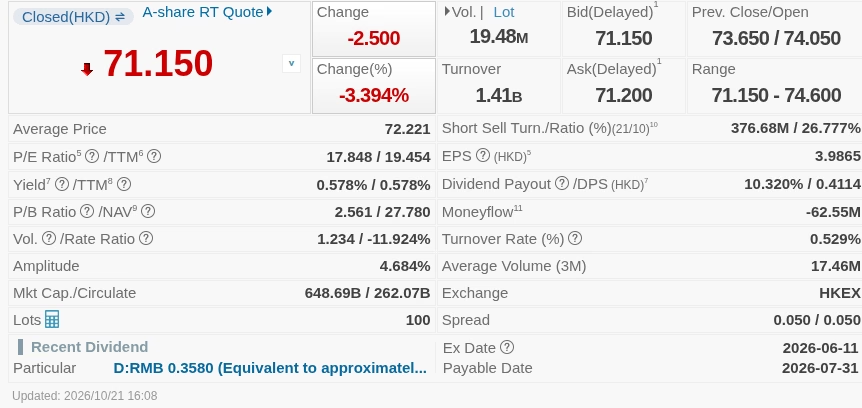
| Last price (21 Oct close) | HK$71.15 |
| Day change | -HK$2.50 (-3.39%) |
| Prev close / open | HK$73.65 / HK$74.05 |
| Day range | HK$71.15 – 74.60 |
| 52-week range | HK$71.40 – 113.40 |
| 52-week performance | -31.52% |
| Market cap (H-share circulating) | HK$648.69B (HK$262.07B) |
| P/E (EPS HK$3.9865) | 17.85x |
| TTM P/E | 19.45x |
| P/B (NAV/share HK$27.780) | 2.56x |
| Dividend yield / DPS / payout | 0.58% / HK$0.4114 / 10.3% |
| SMA 10 / 20 / 50 | 73.500 / 75.317 / 82.066 |
| SMA 100 / 150 / 250 | 84.282 / 90.247 / 93.324 |
| RSI (14) | 29.5 (oversold) |
| MACD / signal / histogram | -2.636 / -2.754 / +0.118 |
| Volume vs 3M average | 19.48M vs 17.46M |
| Turnover | HK$1.41B |
| Short selling share of turnover | 26.8% (HK$376.68M) |
| Moneyflow | -HK$62.55M |
What the numbers tell us (our analysis):
- The P/E gap points to falling earnings. A TTM P/E of 19.5x above the 17.8x headline P/E means trailing earnings (about HK$3.66 a share, working back from the price) are below base-year EPS of HK$3.99. That is the 1H profit decline showing up. Q3 needs to show the slide is flattening.
- Not a yield play. A 0.58% yield on a 10% payout says BYD is reinvesting, not distributing. The last dividend was RMB0.3580, ex on 11 Jun and paid on 31 Jul.
- Book value as a floor reference. At 2.56x NAV of HK$27.78, BYD is far from a balance-sheet bargain; the floor case rests on cash flow and overseas growth.
- Citi’s target is a long way off. HK$142 is roughly double the HK$71.15 close. Treat it as a sign of how far sentiment has swung, not a 12-month promise.
Technical analysis: the double-bottom test at HK$71
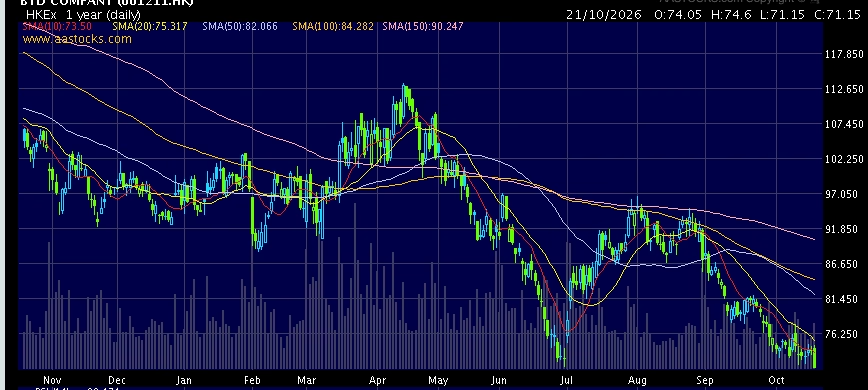
The one-year daily chart is a clean downtrend: from the HK$113.40 peak in April, through a July low in the low HK$70s, a rebound into the mid-HK$90s in August, then a steady slide back down through September and October. Price is now sitting right on the July lows. That is the double-bottom setup market commentary is pointing to.
The bear case is in the moving averages. The stock is below all six AASTOCKS SMAs (10, 20, 50, 100, 150 and 250 days), and they are stacked in bearish order from 73.5 up to 93.3. Every rally has a ceiling right above it.
The bull case is in the momentum:
- Oversold. RSI(14) at 29.5 is below 30 for the first time in a while.
- MACD turning. MACD at -2.636 has just crossed above its -2.754 signal line, a small +0.118 histogram: early, not confirmed.
- Volume tells you who is selling. 19.48M shares versus a 17.46M average on a down day, plus negative moneyflow, means the low is still being tested. Short selling at 26.8% of turnover is high, which is also the fuel for any short-covering pop Citi expects.
Levels: support at HK$71 (the 52-week-low area, with the AASTOCKS 52-week low printed at HK$71.40 and Wednesday’s close at HK$71.15). First resistance is the HK$73.5–75.3 zone of the 10- and 20-day SMAs, then HK$82 (50-day). A double bottom only counts if HK$71 holds on a closing basis and price reclaims the 20-day line. We made the same point about the 250-day “gatekeeper” line in our ANTA Sports (02020) stock analysis: in this tape you wait for the chart to confirm the story.
Risks
- Double bottom fails. A decisive close below HK$71 would turn the support into a breakdown, with no recent chart support underneath.
- Price war at home. Revenue -7.1% and profit -20.5% show the domestic squeeze is real; Q3 could disappoint.
- Sector contagion. CATL’s 11% plunge, HSTECH at a 2+ year low and Citi’s weak battery peak-season note show the whole supply chain is under pressure.
- Regulation. The 20 Oct symposium on design and R&D testing management signals tighter oversight of automakers.
- Europe execution. The 350,000-unit hybrid quota limits exports, and Szeged has to ramp on time to offset it.
- Heavy short selling. More than a quarter of turnover is short selling; short covering can help, but shorts are still pressing.
What to watch
- Q3 results at end-October. Compare with Citi’s RMB12.95bn net profit estimate (ex-FX and BYD Electronic).
- HK$71 on a closing basis. Hold it and the double-bottom case lives; lose it and stand aside.
- Reclaiming HK$73.5–75.3. A close back above the 10- and 20-day SMAs would be the first confirmation.
- Overseas sales and margins. The overseas share is the whole bull case; watch monthly export numbers.
- Szeged start-up timing ahead of the 1 Dec 2026 EU arrangement.
The DimSumInsider take
BYD is a tale of two businesses: a domestic franchise grinding through a price war and an overseas business growing almost 70% with better margins. The European overhang now has a ceiling, Hungary is close, cash flow is up and Citi says Buy at HK$142. The chart, though, is still in a downtrend with every moving average overhead. Our approach: HK$71 is the line. Oversold RSI and a fresh MACD cross give the double bottom a real chance, especially with heavy short interest into Q3 results, but we would want a close back above HK$75 before calling the bottom. The alpha here is buying confirmation near support, not catching a falling knife in a sector that is still being sold. For more HK rotation ideas, see our Kingsoft (03888) stock analysis.
FAQ
Why did BYD (01211) shares fall to a 52-week low?
Domestic price competition, slowing China growth, worries about European restrictions and sector-wide selling (CATL fell more than 11% on 21 Oct) pushed BYD down 3.4% to HK$71.15 (AASTOCKS, 21 Oct 2026 close).
What is the EU-China deal on Chinese EVs?
A minimum-price arrangement on EV tariffs from 1 Dec 2026, with imports of China-made hybrids (HEV and PHEV) capped at 350,000 units a year for four years. Chinese brands assembling locally are exempt.
What is Citi’s target price for BYD?
Citi maintains Buy with an H-share target of HK$142 and expects Q3 net profit of RMB12.95bn, excluding FX and BYD Electronic (00285).
What are the key technical levels for 01211?
Support at about HK$71 (52-week-low area) and first resistance at HK$73.5–75.3 (10- and 20-day SMAs). RSI(14) is 29.5, in oversold territory.
When does BYD report Q3 2026 results?
At the end of October 2026.
Disclaimer: For information only. Based on public market commentary notes, broker views and AASTOCKS data as of 21 Oct 2026 close; data may be delayed. DimSumInsider may hold positions not stated here. Consult a licensed financial adviser. This is not financial advice. Do your own research.
Leave a Reply