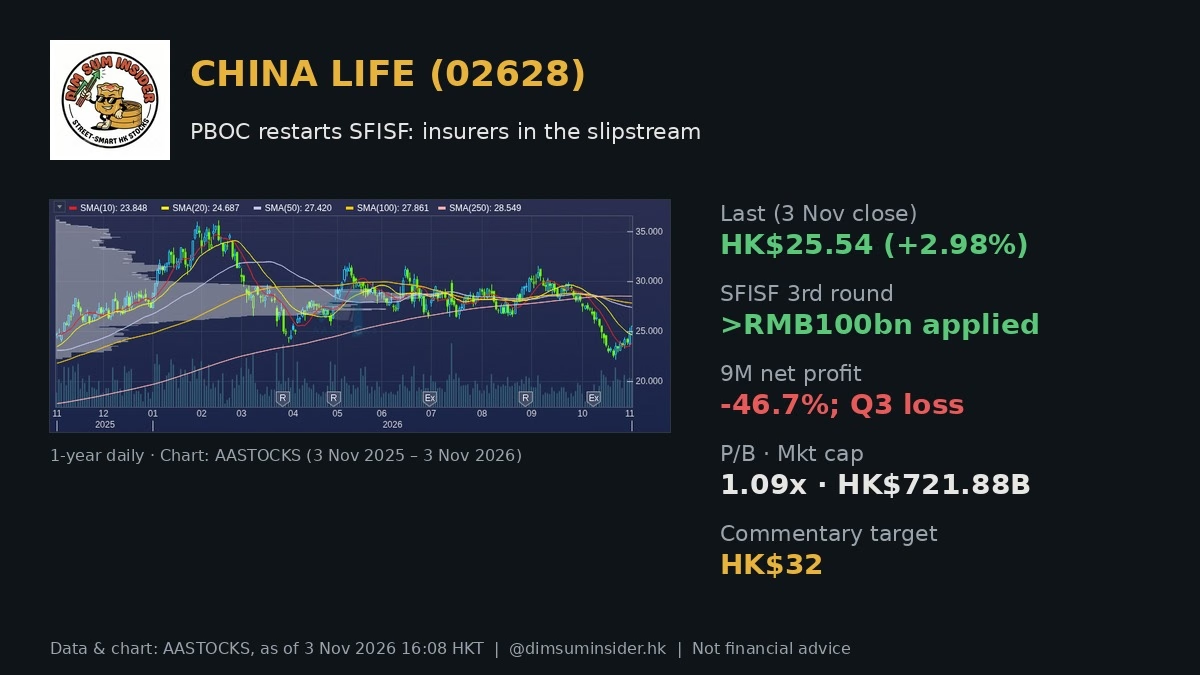
China Life Insurance (02628), listed as CHINA LIFE on AASTOCKS, rose 2.98% to HK$25.54 on Tuesday 3 Nov, after a 3.9% gain to HK$24.80 the session before. The trigger is policy: the PBOC has restarted its Securities, Funds and Insurance companies Swap Facility (SFISF), and the third operation drew reported applications of more than RMB 100bn. This China Life 02628 stock analysis asks whether that liquidity support can outweigh a nine-month profit drop of 46.7% and a Q3 loss.
Market commentary notes, which suggested buying at HK$26 in June, say holders can keep the stock and new buyers can buy at the current level, with a target of HK$32. We think the SFISF story is a real tailwind, but China Life’s earnings now move with the A-share market, so the stock is a leveraged bet on mainland equities holding up.
Key takeaways
- SFISF is back. The PBOC has started a third SFISF operation. Market commentary notes report 31 institutions applied for more than RMB 100bn, about double the RMB 50bn and RMB 55bn of the two earlier rounds.
- Insurers benefit. Brokers and insurers are the facility’s users. Insurers are also being officially encouraged to raise equity allocations, which ties their results more closely to the stock market.
- Profit hit by A-shares. China Life’s 9M net profit fell 46.7% to RMB 89.43bn, and Q3 alone was a loss of RMB 45.1bn, mainly due to A-share swings.
- The core business is growing. 9M new business value rose 13%, the strongest among peers according to Morgan Stanley (as cited in the notes). Base (operating) profit rose 15.8% to RMB 94bn.
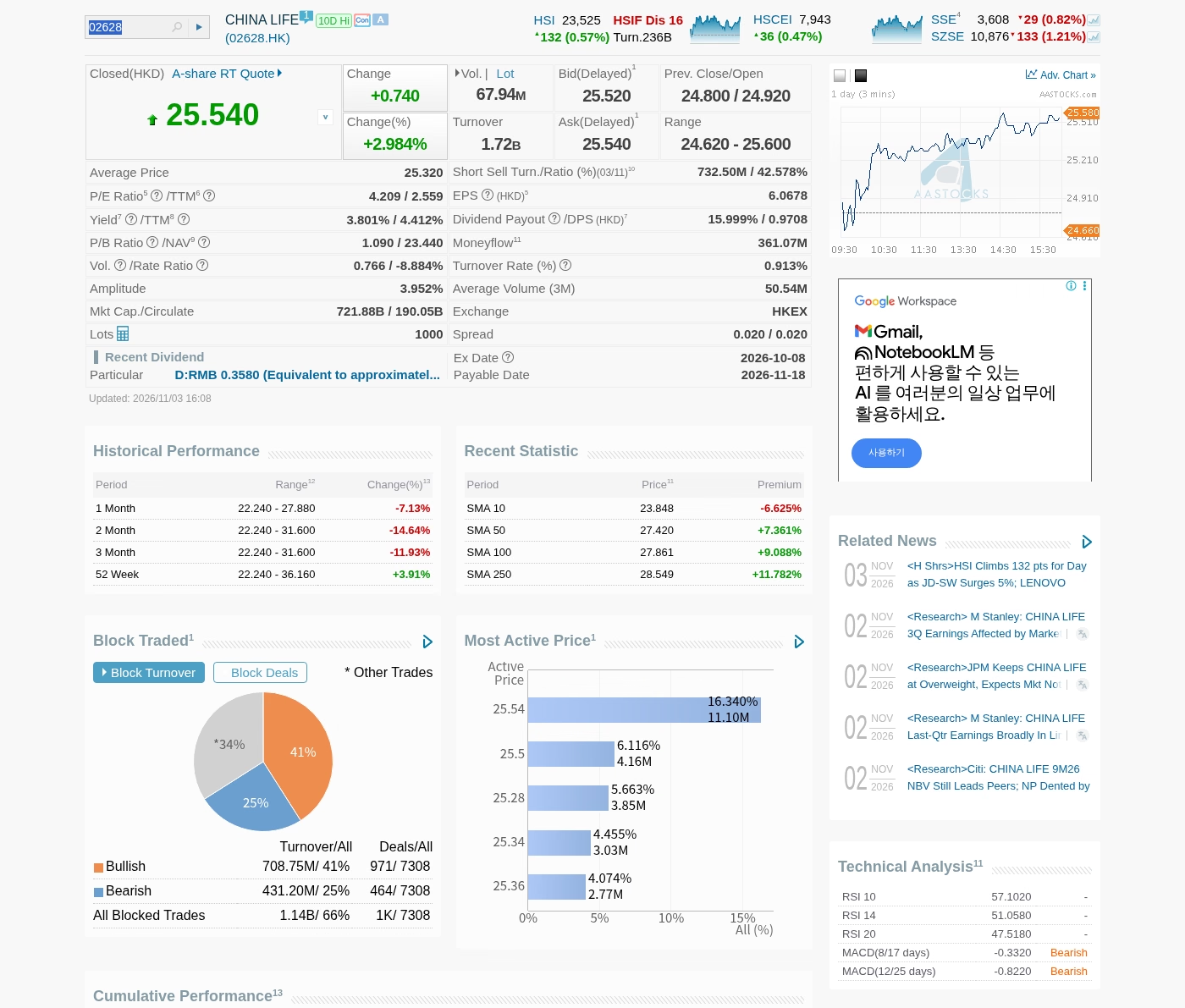
- Valuation. AASTOCKS shows P/E 4.21x (TTM 2.56x), P/B 1.09x (NAV HK$23.44), yield 3.80% (TTM 4.41%) and a market cap of HK$721.88B.
- Commentary stance. Holders keep; new buyers can buy at the current level; target HK$32.
What is the SFISF? A quick explainer
The Securities, Funds and Insurance companies Swap Facility (SFISF) was created by the People’s Bank of China in October 2024. It is one of two market-support tools launched then, and is aimed at non-bank financial firms.
- How it works. Eligible brokers, fund managers and insurers pledge less-liquid assets they hold, such as bonds, equity ETFs and CSI 300 constituent shares, to the PBOC. In return they receive highly liquid, high-grade assets such as treasury bonds and central bank bills.
- What the cash is for. Those high-grade assets can be pledged or sold to raise funding, but the rules say the money can only be used to invest in the stock market.
- Why it exists. The aim is to unlock liquidity in non-bank institutions and improve their ability to buy and hold stocks and to absorb market shocks.
- Track record. The PBOC ran two earlier operations, in October 2024 and January 2025. Market commentary notes point out that the Shanghai Composite rose by a decent margin after both.
- This round. The third operation drew reported applications of more than RMB 100bn from 31 institutions, versus RMB 50bn and RMB 55bn in the first two. Commentary notes read the larger size as stronger support for the market.
Why insurers like China Life benefit
Brokers gain in an obvious way: more market activity and cheaper funding for equity positions. For insurers, the link is newer. Regulators have been encouraging insurers to put more of their assets into equities, so the relationship between stock market performance and insurers’ results has become tighter. If a bigger SFISF round helps steady the A-share market, insurers’ investment returns, and therefore reported profits, should benefit too.
The same link works in reverse. China Life’s Q3 loss shows how fast a weak A-share market now flows through to the income statement.
China Life 9M results at a glance
| Item | 9M 2026 | Change |
|---|---|---|
| Net profit | RMB 89.43bn | −46.7% YoY |
| Q3 net profit | Loss of RMB 45.1bn | Mainly due to A-share falls |
| New business value (NBV) | — | +13% YoY |
| Base (operating) profit | RMB 94bn | +15.8% YoY |
The split is clear. The investment line, which is exposed to A-share moves, drove the profit fall. The insurance business itself is doing well: NBV growth of 13% is, according to Morgan Stanley, the best among peers. Base profit of RMB 94bn (+15.8%) is the figure commentary notes link to dividend capacity. Morgan Stanley maintains a Buy on China Life H shares with a target of HK$38.8 (as cited in the notes).
China Life 02628 stock analysis: valuation
| Metric | China Life (02628) |
|---|---|
| Last price (2026/11/03 close) | HK$25.540 |
| Day change | +HK$0.740 (+2.984%) |
| Prev close / open | HK$24.800 / HK$24.920 |
| Day range | HK$24.620 – 25.600 |
| 52-week range | HK$22.240 – 36.160 |
| Market cap | HK$721.88B |
| P/E / TTM P/E | 4.209x / 2.559x |
| P/B (NAV HK$23.44) | 1.090x |
| Dividend yield / TTM | 3.801% / 4.412% (DPS HK$0.9708) |
| Volume / turnover | 67.94M / HK$1.72B |
| Commentary checkpoints | Figure |
|---|---|
| Earlier call | Suggested buying at HK$26 in June |
| Holders | Keep holding |
| New buyers | Can buy at the current level |
| Target | HK$32 (~25% above HK$25.54) |
| Broker view cited | Morgan Stanley: Buy, target HK$38.8 |
What the numbers tell us (our analysis):
- Low P/E, volatile earnings. A trailing P/E of 2.56x reflects a strong earnings base that is now shrinking. The 46.7% profit drop means trailing figures flatter the stock.
- Close to book. At 1.09x NAV, the market is not paying much of a premium for the growing new-business franchise.
- Income support. A 3.80% yield (4.41% TTM) gives holders something while they wait. AASTOCKS lists the latest dividend as RMB 0.358, ex-date 2026-10-08.
- Back near the June entry. The price is just below the HK$26 level in the earlier call, so the original thesis has not made money yet.
Technical analysis: rebound from the October low
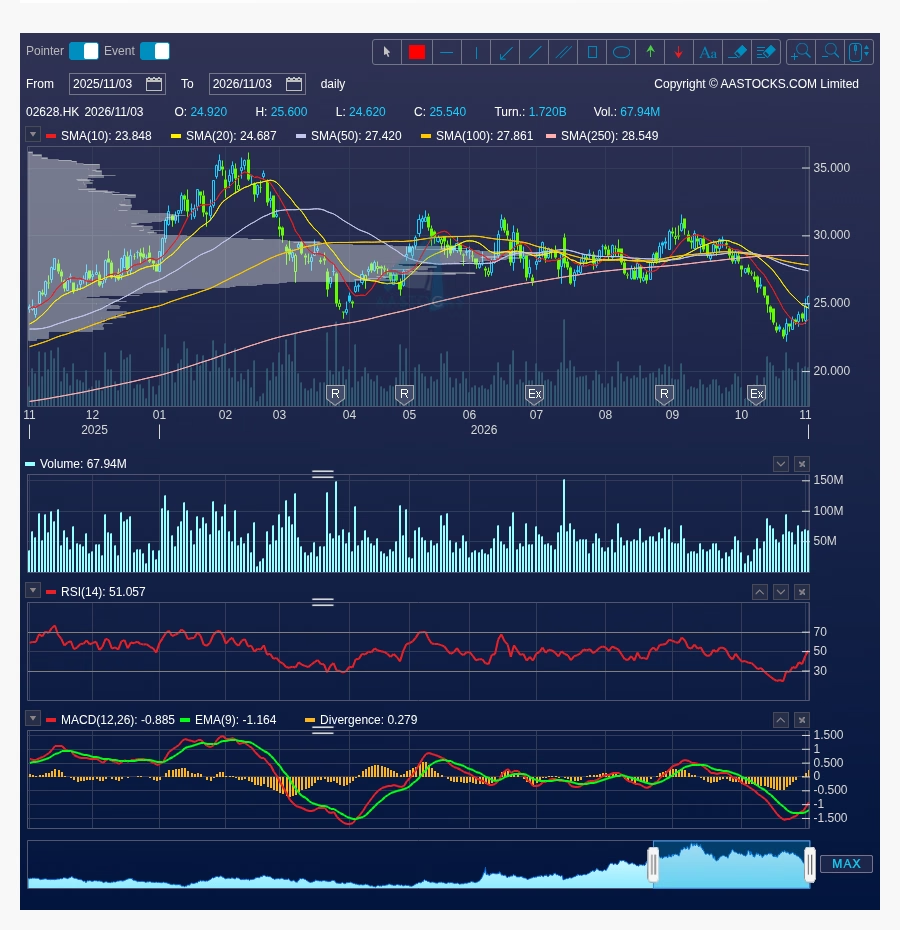
The AASTOCKS one-year daily chart (3 Nov 2025 to 3 Nov 2026) shows a peak near HK$36.16 in February, a long range around HK$27–31 through the summer, and a sharp drop in October to the 52-week low of HK$22.24. The stock has rebounded on two strong days.
- Moving averages. The price of 25.54 is back above SMA10 23.848 and SMA20 24.687, but still below SMA50 27.420, SMA100 27.861 and SMA250 28.549.
- Momentum. RSI(14) is 51.1, neutral. MACD(12,26) is −0.885 against a signal of −1.164 (divergence +0.279). That is a bullish crossover from below zero: momentum is improving, but the trend has not turned positive yet.
- Support. HK$24.6–24.7 (day low and SMA20), then SMA10 23.85, then the HK$22.24 low.
- Resistance. HK$25.60 (day high), HK$26 (the June entry), then HK$27.4–28.5 (SMA50/100/250), then the commentary’s HK$32 target.
Risks
- A-share sensitivity. Q3 showed that a weak A-share market can push China Life into a quarterly loss. Higher equity allocation makes this stronger.
- Policy may not be enough. Earlier SFISF rounds helped sentiment, but a liquidity tool does not guarantee lasting gains.
- Low interest rates. Falling bond yields pressure investment returns and the spread on long-dated liabilities.
- Trend still down. The price is below SMA50, SMA100 and SMA250. A failure around HK$26–27.4 would keep the downtrend intact.
- Estimates can change. Broker targets and commentary targets are views, not guarantees.
The DimSumInsider take
China Life is a clean way to express a view on mainland equities. The SFISF restart, at about double the size of earlier rounds, adds support at a time when the stock has just bounced off its 52-week low. The core business is healthy, with NBV up 13% and base profit up 15.8%, while reported profit swings with the A-share market. We agree with the commentary’s stance: holders keep, and new money can start at the current level. We would look for a close above SMA50 (HK$27.42) as confirmation, treat HK$32 as the target, and reassess if the price falls back below SMA10 (HK$23.85).
FAQ
What is the SFISF?
It is the PBOC’s Securities, Funds and Insurance companies Swap Facility, launched in October 2024. Eligible brokers, funds and insurers swap bonds, equity ETFs and CSI 300 shares for treasury bonds or central bank bills, and the funding raised can only be used to invest in stocks.
Why does the SFISF matter for China Life?
Insurers are users of the facility and are being encouraged to hold more equities. A stronger A-share market supports insurers’ investment returns and profits.
What were China Life’s 9M 2026 results?
Net profit fell 46.7% to RMB 89.43bn, and Q3 was a loss of RMB 45.1bn, mainly due to A-share swings. New business value rose 13% and base profit rose 15.8% to RMB 94bn.
What is China Life’s valuation?
According to AASTOCKS as of the 2026/11/03 close: HK$25.54, P/E 4.21x (TTM 2.56x), P/B 1.09x, yield 3.80% (TTM 4.41%) and market cap HK$721.88B.
What levels matter for 02628?
Support is at HK$24.6–24.7, then HK$23.85, then HK$22.24. Resistance is at HK$25.60, then HK$26, then HK$27.4–28.5, then HK$32.
Disclaimer: For information only. Based on public market commentary notes, company results and broker views as reported, and AASTOCKS data as of 2026/11/03 16:08 HKT (market Closed); data may be delayed. SFISF application figures are as reported, and targets are forward-looking estimates. DimSumInsider may hold positions not stated here. Consult a licensed financial adviser. This is not financial advice. Do your own research.