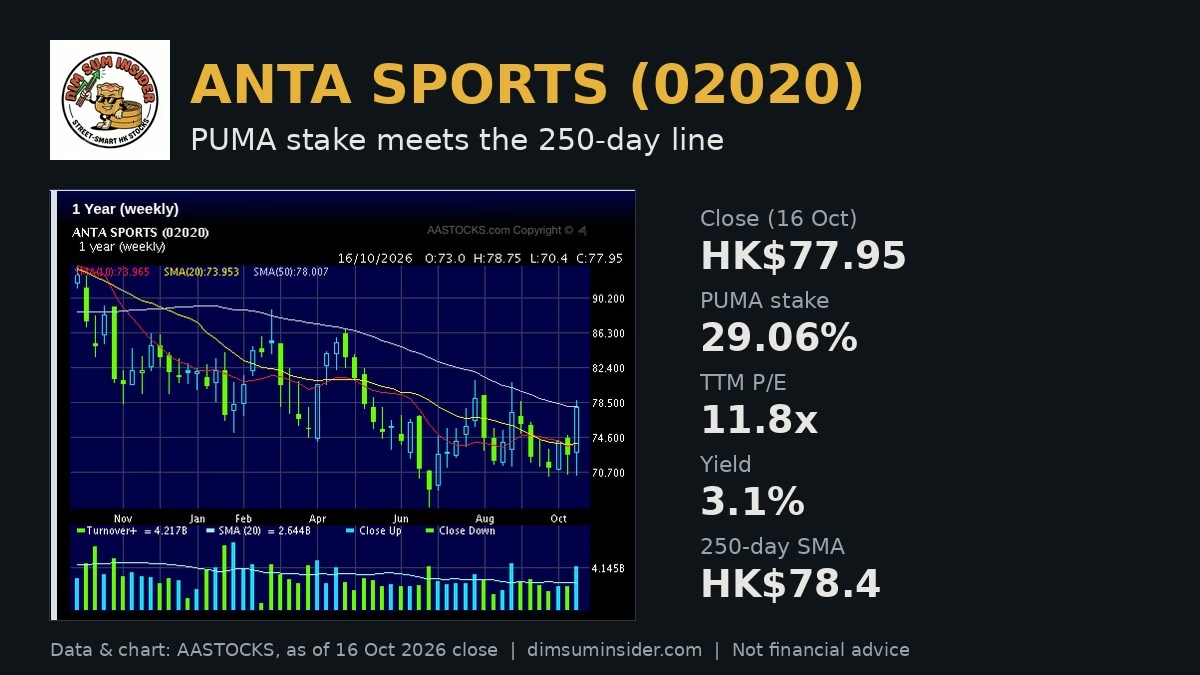
Most of the market filed China sportswear under “weak consumer, skip it” months ago. The tape is starting to argue back. ANTA Sports (02020) has just become PUMA’s largest shareholder and the stock has climbed for several straight sessions. This ANTA Sports 02020 stock analysis asks one question: is this a real re-rating, or a rally running into a wall?
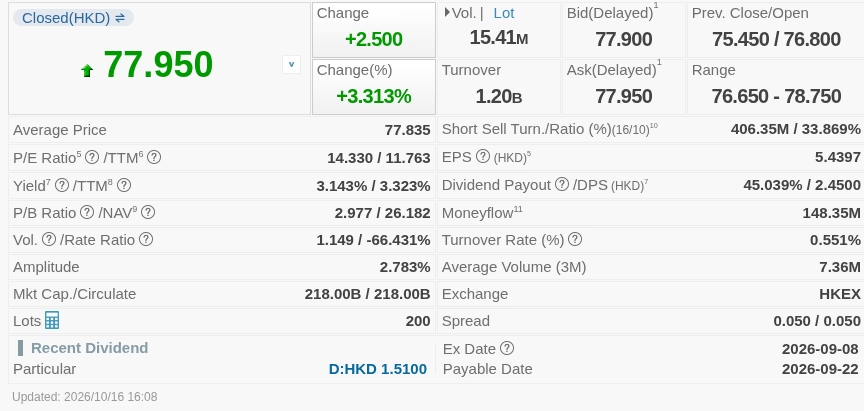
It closed Friday 16 Oct at HK$77.95, up 3.3% on more than twice its 3-month average volume. That left it just under the one line that matters on the chart: the 250-day moving average near HK$78.4.
The news in brief
- On 7 Oct 2026 ANTA announced it had completed the purchase of about 29.06% of PUMA for EUR1.506bn, making it the German brand’s largest shareholder.
- PUMA joins a stable that already includes FILA, SALOMON, DESCENTE, JACK WOLFSKIN and ARC’TERYX alongside the core ANTA brand, which competes head-on with NIKE and ADIDAS. The deal is a milestone for ANTA’s “single focus, multi-brand, globalisation” strategy.
- The bull case centres on China: PUMA’s Greater China sales are only about 7% of its total, against 17% to 30% for global sportswear peers.
- Macro backdrop: China’s September CPI rose 0.9% year on year, near a three-month high, but on raw material and energy costs rather than a demand recovery.
- Street chatter’s technical call: the stock has risen for days, a break of the 250-day bull/bear line would open further upside, and dips are for accumulating.
- Goldman Sachs cut its ANTA target price to HK$105 on 15 Oct and kept its Buy rating (AASTOCKS news headline).
- Diary note: the Hong Kong market is closed on Monday 19 Oct 2026 for a holiday and reopens Tuesday 20 Oct.
Why PUMA matters: the multi-brand playbook
ANTA’s pitch has never been “one brand to beat NIKE”. It is a portfolio: a mass-market home brand, premium and outdoor labels on top, and a group platform that runs retail, supply chain and distribution across all of them. PUMA adds a genuinely global brand to that machine, which is why the strategy is summed up as “single focus, multi-brand, globalisation”.
The China numbers are the heart of the trade. PUMA earns about 7% of its sales in Greater China, while global sportswear peers sit at 17% to 30%. Market commentary argues that ANTA’s turnaround capability and its DTC (direct-to-consumer) model are exactly the tools needed to integrate PUMA into the mainland market and lift its performance there.
Our read: the gap is the opportunity, but we would not put a number on it until management does. Two points keep the bull case honest:
- 29% is influence, not control. ANTA is the largest shareholder, not the owner. It can push a China strategy; it cannot simply impose one. A stake of this size typically means ANTA books a share of PUMA’s profit rather than consolidating its sales.
- Globalisation is also a hedge. With domestic demand still soft, every extra dollar earned outside the mainland makes the group less hostage to the China consumer.
Macro check: China CPI is up, for the wrong reason
China’s September CPI rose 0.9% year on year, close to its biggest gain in three months. Before calling it a consumer comeback, look at the driver: higher raw material and energy costs, not stronger demand. Domestic demand remains weak.
For a consumer brand, cost-push inflation without demand is an awkward mix. Input costs go up while shoppers keep their wallets shut, which limits pricing power and keeps discounting on the table. That is the backdrop ANTA has to trade against, and it is also why the PUMA and global angle carries more weight than another domestic store roll-out would.
ANTA Sports 02020 stock analysis: valuation and key numbers
| Metric | ANTA Sports (02020) |
|---|---|
| Last price (16 Oct close) | HK$77.95 |
| Day change | +HK$2.50 (+3.31%) |
| Day range | HK$76.65 – 78.75 |
| 52-week range | HK$66.85 – 89.30 |
| 1M / 3M / 6M performance | +7.74% / +5.62% / -7.37% |
| YTD / 52-week performance | -3.23% / -9.04% |
| Market cap | HK$218.00B |
| P/E (EPS HK$5.4397) | 14.33x |
| TTM P/E | 11.76x |
| Dividend yield / TTM yield | 3.14% / 3.32% |
| DPS / payout | HK$2.45 / 45.0% |
| P/B (NAV/share HK$26.182) | 2.98x |
| SMA 10 / 50 / 100 / 250 | 73.195 / 73.767 / 73.986 / 78.375 |
| RSI 10 / 14 / 20 | 72.0 / 66.5 / 61.5 |
| MACD (12/25) / (8/17) | 0.336 / 0.779, both bullish |
| Volume vs 3M average | 15.41M vs 7.36M |
| Turnover | HK$1.20B |
| Short-selling share of turnover | 33.9% (HK$406.35M) |
What the numbers tell us (our analysis):
- The P/E gap points to higher trailing earnings. A 14.3x P/E against 11.8x TTM implies trailing earnings above the base-year EPS. Working back from the price, TTM EPS is roughly HK$6.6 against HK$5.44. Check for one-offs before you extrapolate.
- You are paid to wait. A 3.1% to 3.3% yield on a 45% payout is real income for a growth name. The latest HK$1.51 dividend went ex on 8 Sep and was paid on 22 Sep.
- Not deep value. At 2.98x book this is a quality-brand multiple, not a balance-sheet bargain. The re-rating case rests on earnings, not assets.
- Street context. Goldman Sachs’ HK$105 target sits about 35% above Friday’s close, but note that the headline was a cut with Buy maintained. Treat it as context, not a destination.
Technical picture: the 250-day line at HK$78.4
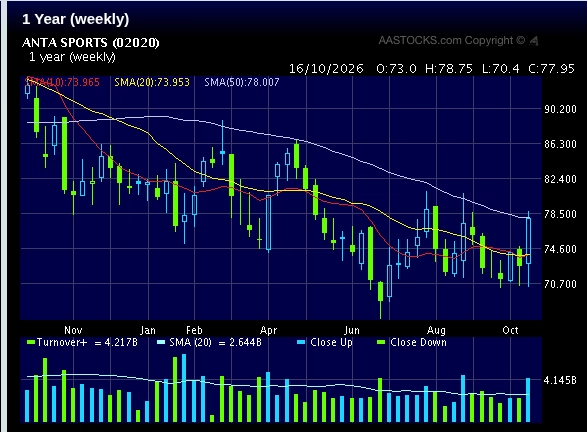
The weekly chart tells the story of the past year: a slide from around HK$90 late last year to a June low (52-week low HK$66.85), then a base. Down 9% over 52 weeks and 3.2% year to date, the stock is up 7.7% over the past month. The 10-, 50- and 100-day SMAs are bunched between HK$73.2 and HK$74.0, and Friday’s 3.3% jump took the price clean out of that cluster.
Now the hard part. AASTOCKS puts the 250-day SMA at HK$78.375, with the price about 0.5% below it. Some market commentary puts the 250-day bull/bear line nearer HK$76.4; different calculation methods place it anywhere in the HK$76–78 zone. We use the AASTOCKS figure, so the line is not yet cleared. Friday’s intraday high of HK$78.75 poked above it, but the close did not hold.
Three flags:
- Volume backs the move. 15.41M shares traded, about 2.1x the 7.36M 3-month average, and both MACD readings are bullish.
- The bears are still here. Short selling was 33.9% of turnover, a heavy share for a large-cap.
- Short-term stretched. RSI(10) at 72.0 is in overbought territory and RSI(14) is 66.5. A pause or pullback before any breakout would be normal.
We flagged the same gatekeeper in our recent Kingsoft (03888) stock analysis: in this tape, the 250-day line separates a bounce from a trend change. For ANTA, a decisive close above about HK$78.4 on volume would confirm the bull case. On any pullback, the HK$73–74 moving-average cluster is the first zone that “accumulate on dips” buyers will be watching.
Risks
- Integration without control. A 29% non-controlling stake gives ANTA influence, not command. EUR1.506bn is committed, and the China plan depends on PUMA’s board and management agreeing to it.
- Weak China consumption. CPI is rising on costs, not demand. If the consumer stays soft, margins across the whole portfolio feel it.
- PUMA’s own brand issues. The bull case assumes PUMA can be fixed. If brand momentum stays weak globally, a better China business may not offset it.
- Overbought. RSI(10) above 70 raises the odds of a near-term pullback.
- Still below the 250-day SMA. Friday’s intraday break failed to hold at the close.
- Heavy short selling. About a third of Friday’s turnover was short selling.
- Target cut. Goldman Sachs kept its Buy rating but lowered its target, a reminder that estimates are moving the wrong way at the margin.
What to watch
- The close above about HK$78.4. One poke intraday is not a break. Watch for closes above it on above-average volume after the market reopens on Tuesday 20 Oct.
- Pullback behaviour. If RSI cools, does the stock hold the HK$73–74 SMA cluster?
- PUMA China plan. Any detail from ANTA on how it will work with PUMA in the mainland: governance, DTC, distribution.
- China consumption data. Does inflation start coming from demand rather than costs?
- Short-selling ratio. A falling short share alongside rising prices would signal the bears are covering.
The DimSumInsider take
ANTA has turned a weak-consumer story into a global multi-brand story, and the PUMA stake is the clearest proof yet. The China gap (7% versus 17% to 30% for peers) is a real, simple thesis, and at 11.8x TTM P/E with a 3%+ yield you are paid while it plays out. But the chart has not confirmed it: the price sits just below the 250-day line at about HK$78.4, RSI is stretched and short sellers are active. Our approach: let the line decide. A decisive close above HK$78.4 on volume is the trigger; until then, dips towards HK$73–74 are where patient money gets the better entry. The alpha is in waiting for the market to prove the story, not in chasing the first green candle.
FAQ
What did ANTA Sports (02020) buy in PUMA?
ANTA announced on 7 Oct 2026 that it had completed the purchase of about 29.06% of PUMA for EUR1.506bn, making it PUMA’s largest shareholder.
Why could PUMA grow in China under ANTA?
PUMA’s Greater China sales are only about 7% of its total, against 17% to 30% for global sportswear peers. Market commentary suggests ANTA’s turnaround capability and DTC model could help close part of that gap.
Is ANTA Sports stock cheap?
Per AASTOCKS (16 Oct 2026 close): 14.3x P/E, 11.8x TTM P/E, 2.98x book and a 3.1% yield (3.3% TTM).
What is the key technical level for 02020?
The 250-day SMA at about HK$78.4 (AASTOCKS). Different calculation methods put the line in the HK$76–78 zone. The stock closed at HK$77.95 on 16 Oct.
Is the Hong Kong market open on 19 Oct 2026?
No. HKEX is closed on Monday 19 Oct for a holiday and reopens on Tuesday 20 Oct.
Disclaimer: For information only. Based on public market commentary and AASTOCKS data as of 16 Oct 2026 close; data may be delayed. DimSumInsider may hold positions not stated here. Consult a licensed financial adviser. This is not financial advice. Do your own research.